

News
By Li Tingting,April 18, 2015.
At 6:30 pm, April 16, 2015, the lecture themed “The Legal Problems and Risk Prevention for P2P” was given by Dr. Wu Weiming, a lawyer working with AllBright Law Offices, in Room 201, 2ed Teaching Building, Guoding Campus. Dr. Wu has profound theoretical basis and rich experience in practice. Students have learnt a lot from his lecture. The lecture was hosted by Song Xiaoyan, professor of SHUFE Law School and it lasted about two hours.
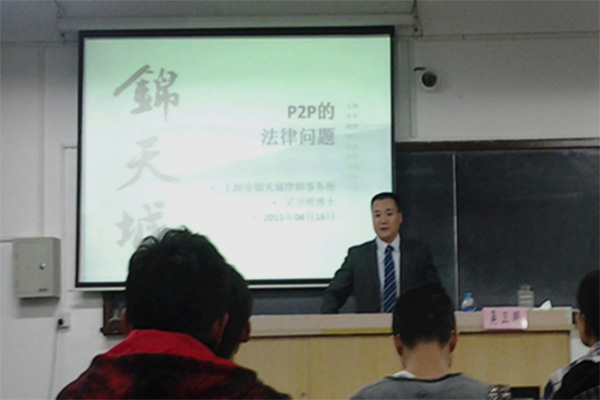
At first, Dr. Wu said that P2P was a result of the long-term development of electronic commerce and Internet Finance instead of a rise in the overnight. It is a process from the qualitative change to the quantitative. Financial Internet has not share the same concept with the Internet Finance. It is mainly referred to electronic payment, bank transfer system and issue of stocks and bonds, while the Internet Finance mainly takes advantage of the convenience and efficiency of the Internet Finance to rearrange financial actors and elements which is a product combined the creation and use of Internet tools, the reform of financial activities with the development of financial products. In fact, Internet Finance is not a new concept. In a word, Financial Internet uses Internet to do business and Internet Finance combines financial products with the help of Internet.
As for the background of the rise of Internet Finance, there are aspects summarized by Dr. Wu, including the development of information technology, the network security technology and trade habits. These aspects promote the rise of Internet Finance which contributes to long-tail-effect. Long-tail-effect is a very important theoretical basis of Internet Finance and small customers can get profit through trading on Internet with it. In the opinion of Dr. Wu, the first problem to be solved is trust. In order to safeguard the long-term and good development of Internet Finance, we have to resolve the problem of trust and safety on Internet. Dr. Wu thought the impacts of the Internet involved the impact on concept, financial landscape, regulatory and law. The reason of the impact to the concept is that participating people are increasingly widespread. Meanwhile, the remote trade can make more and more people enjoy financial services. Some new financial ways and new financial tools lead to the impact to financial landscape. The impact to law is under the influence of the legislative lag, so our legislative should speed up legislating and perfect laws and regulations of the Internet Finance to promote the safety and efficient development of it.
Then Dr. Wu put more importance on the legal problems of P2P. There are two modes for it, private debit and credit sides and the transferal of creditors’ rights. The legal basis of them can be got in the General Principles of the Civil Law of the People’s Republic of China and the Contract Law of the People’s Republic of China. One of the common problems about P2P is raising fund illegally. There are various ways to do it, such as illegally absorbing public deposits, raising fund fraudulently and issuing stocks, corporate and company bonds without authorization. Another common legal problem for P2P is the subject identification. It’s often difficult to identify the subject. Dr. Wu provided some good solutions. We can set up electronic identity card or take advantage of the third-party data. The essence of P2P, in Dr. Wu’s view, is a virtual bank. It cleverly avoids the risk that one makes loans from many people. As for the future of P2P, Dr. Wu hoped that we could further eliminate the information asymmetry and reduce the cost of transactions. At last, Dr. Wu summarized P2P’s modes. He thought that P2P was a financial mode through which customers can make direct transactions. At present, P2P, with financial functions, should be regulated by traditional civil law. However, what can be expected is that it will be a trend to make P2P in the scope of financial regulations and P2P or some similar trade ways will lead to the mode change of deposits and loans in traditional banks. Furthermore, he said the present P2P market is still in the attempting stage, so we had better be cautious to deal with law risks.
Before the end of the whole lecture, many students raised some interesting questions to Dr. Wu and they all got comprehensive and satisfying answers. We feel very fortunate to have this chance to invite Dr. Wu to pass on his knowledge to us. The lecture ended up with students’ warm applause.

© 2012 School of Law, Shanghai University of Finance and Economics
 沪公网安备31011002001712号