

News
Translated by Regina Rao, revised by Susan Wu, April 25th ,2014.
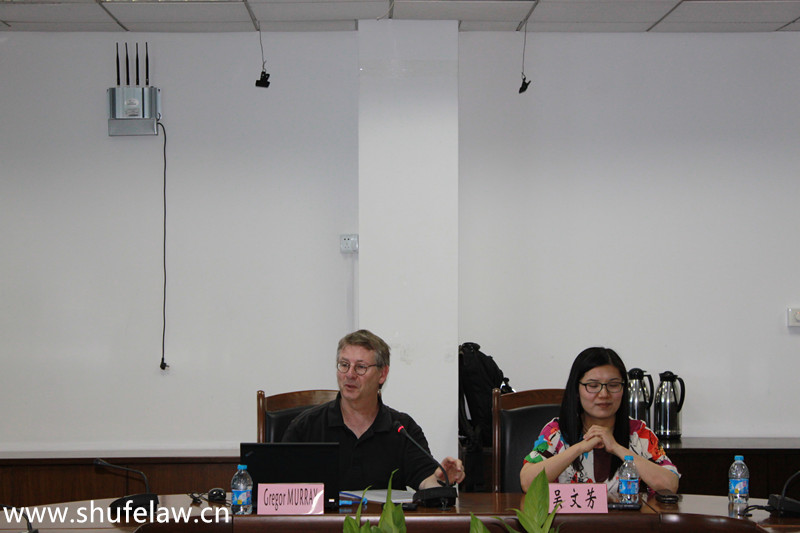
On the afternoon of April 25th, 2014, Professor Gregor Murray from the University of Montreal Industrial Relations College delivered a speech to our faculty and students in the meeting room on the 5th floor of administrative building. The topic is “Varieties of Collective Bargaining: Building Blocks for a Collective Bargaining and Dispute Resolution Regime” and the speech was hosted by Dr. Wu Wenfang.
To begin with, Prof. Gregor Murray argued that the reasons for the collective bargaining development can be categories into three levels including workers’ level, company level and social level. From the workers’ level, collective bargaining can promote individual dignity of workers, advocates in favor of the rights of workers to ensure that workers’ voice can be heard, to allow workers to have more control over working hours and better work-life balance, including wages, benefits and the improvement of working conditions. The reasons can be found in the development of collective bargaining from company level that it can resolve disputes, optimize human resources system, and institutionalize negotiation mechanism. Good negotiation mechanism can help companies to improve productivity, to attract qualified workers, to reduce employee turnover rate, to improve the transparency of business operation as well as accountability. At the social level, development of collective bargaining is beneficial to form a more equitable social distribution system. Meanwhile, it can resolve the problems in labor market to some extent through effective dialogue and innovative ways. It has great value in some social aspects that improving social working condition, improving social security by means of a more democratic governance.
When talking about the challenges that collective bargaining would meet, prof. Gregor Murray believes that when facing a labor disputes, the industry should pay more attention to industrial factors other than geographical factors to the development of different types of collective bargaining. Local legislative authority should be broaden as much as possible so that each jurisdiction has its own labor court or experts from labor relations committee to make their own decisions or rulings. Big country develops their collective bargaining by typing the bargaining, according to structure and determinants factors such as the employer type, network distribution, the impact of labor scarcity, seasonal work and by considering dynamic interaction among the factors. It should be a combination of both “top to bottom” and “bottom to top” systems to establish model for the development of collective bargaining. Although in most countries, the collective bargaining and its regulation hardly create the “top to bottom” system because they occur at different times, in different places and under specific conditions, but in the early period of establishing the collective bargaining systems, the “top to bottom” system of collective bargaining can’t be ignored.
At the end of speech, Prof. Gregor Murray detailedly answered questions raised by students about the labor disputes. The speech ended successfully at the applause of faculty and students.
Original Site: http://law.shufe.edu.cn/structure/xyxwxx_153747_1.html

© 2012 School of Law, Shanghai University of Finance and Economics
 沪公网安备31011002001712号