

News
By Lesley Gao & Susan Wu. December 14, 2013
Joshua E. Bienstock, Esq., an experienced attorney from America was invited to give us a public speech about the American collective bargaining and negotiation on December 11 by SHUFE Law. He told us that we have many ways to solve disputes such as negotiation, mediation, arbitration and litigation. Negotiation is a private way to seek an agreement between the union and the employer. It is less formal and public, but it is less costly and more efficient. So collective bargaining has become a very important way to solve work disputes from these years. Mr. Bienstock introduced the process of the collective bargaining for us by recalling the history of the collective bargaining in advance.
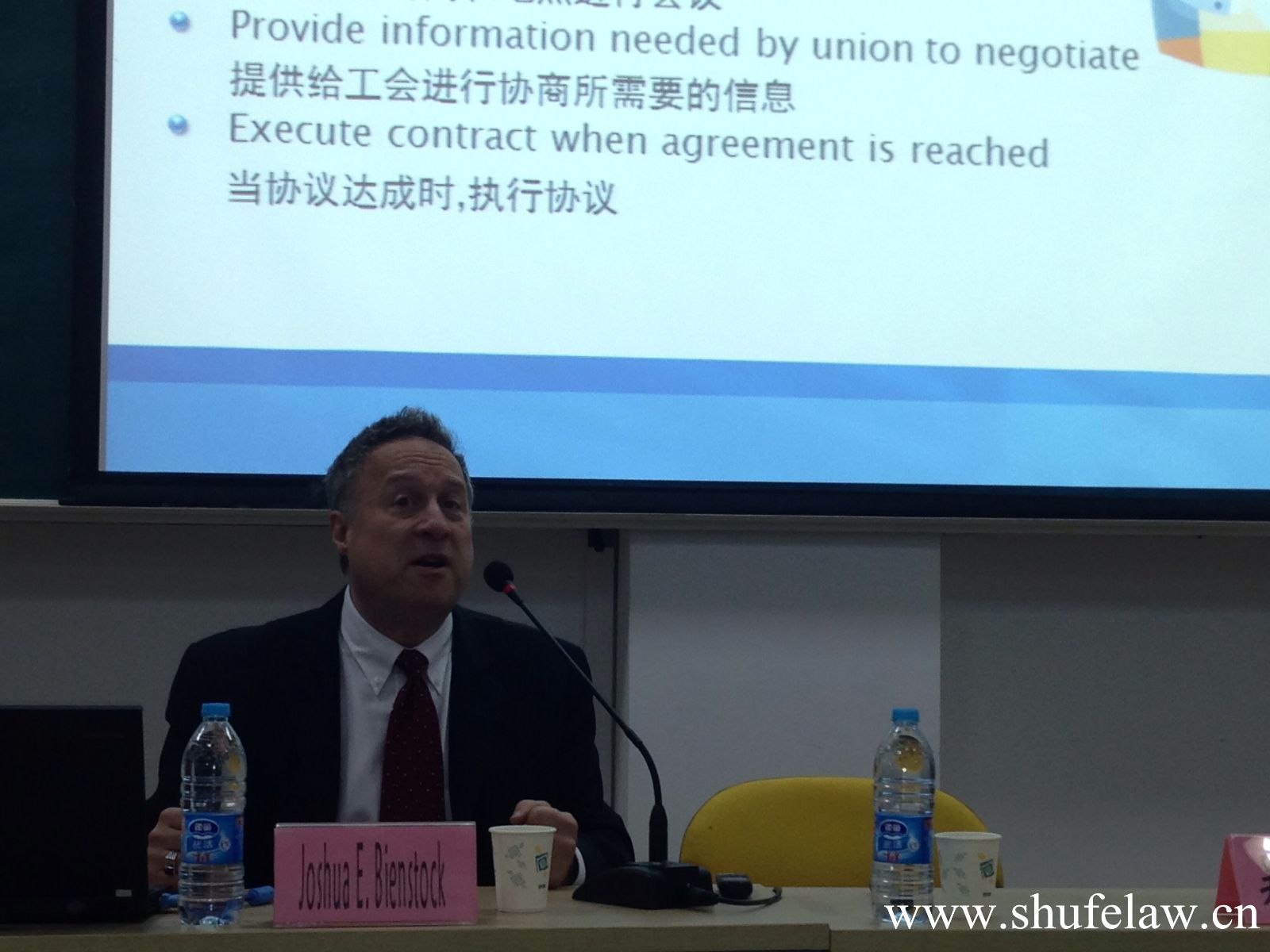
Collective bargaining has existed since 1700s and a group of workers represented by union safeguarded their rights by negotiating with the employers in the year of 1935. Workers need the help of the union because they lack the bargaining strength and negotiation knowledge. Union has greater power and skills, they negotiate with the financially and powerful employers on behalf of all employees. When goes to a collective negotiation, the roles of management, labor (represented by union) and the government are independent. Mr. Bienstock said that we need the good faith bargaining which composed of four elements. Discuss mandatory subjects of collective bargaining. Meet at reasonable times and locations. Provide information needed by union to negotiate. Execute contract when agreement is reached. As he mentioned that our goal is to reach a desirable and durable result and reach an agreement efficiently and fairly and also to keep the relationship intact. We initiate a good faith bargaining to reach a mutually acceptable resolution by four steps. Firstly we should separate the people from the problem, secondly we should focus on the interests, thirdly we should create multiple options for mutual gain, and at last we should rely on objective criteria to test the effectiveness of the proposed grievance resolution. The attitude during the process of the collective bargaining is also very important. We need a positive view and learn to learn from the past.
“We need a BATNA—Best Alternative to a Negotiation Agreement” said Mr. Bienstock at the end of his speech, “if we failed to reach an agreement, we must compare the agreement with the BATNA. Employers need other options and we try to select the best option.” Mr. Bienstock ended his speech and left us to think that what different parties in the collective bargaining can do during the process of negotiating. We learned pretty much from this lecture.

© 2012 School of Law, Shanghai University of Finance and Economics
 沪公网安备31011002001712号