

News
By Saren Abgaryan. October 23, 2013.
Carolyn Sappideen, an experienced professor from the University of Western Sydney , delivered a lecture to students at SHUFE Law on the topic of “Medical Errors and the Medical Profession: the Shift From Individual Blame to System Failure” in the evening of 20th of October, 2013. The lecture was hosted by Dr. Zhao Xiaobo who is an alumnus of University of Western Sydney.
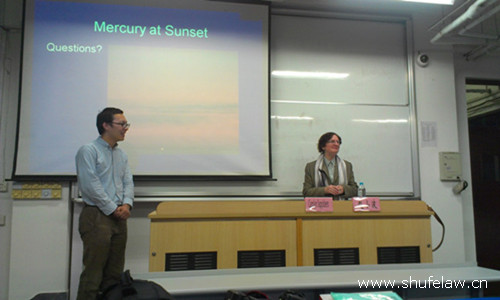
Professor Carolyn Sappideen started her speech by giving some background information on medical malpractice and medical errors, and the compensation that people get in case of being the object of it. As an example, she mentioned that even though the cost of negligent claim is very high, and in case of every person getting compensation for medical errors, it would be extremely expensive for hospitals, however, only 4 percent of the people eventually get compensation. Then she illustrated the system errors by “Swiss Cheese Model”. She also suggested that it’s usually difficult to figure out what was the defect of the system that caused the harm to the client. The factors might differ from case to case starting from the lack of training to the lack of communication with co-workers.
The other important point was that when trying to identify system defects, we should not focus on one part of it, blaming one of the practitioners, for making the mistake. Rather we need to go beyond it to see the good picture of the system. Theoretically, a good way to identify the holes of it is the disclosure of the errors and near misses. However, as the practice shows, disclosure cannot give much data about the system, because they are very weak in almost all countries.
In the end of the lecture, Professor Carolyn Sappideen switched the focus of the topic to individual responsibility, mentioning that for improving the care of patients we need to make sure that people who take the responsibility are going to act more responsible. Looking from the patients’ perspective, she stated that after medical errors, patients want to know what actually happened, they want to get an apology from the hospital instead of purely compensation and they want to see the desire of hospital that the mistake is not going to be repeated.
After the lecture, because of engaging presentations, SHUFE Law students asked varied questions and exchanged their opinion with the professor on the facts of medical situation in China. The lecture gave students a deeper understanding of medical malpractice, and intrigued them to go deeper into the topic.

© 2012 School of Law, Shanghai University of Finance and Economics
 沪公网安备31011002001712号